The Gambler's Mask: How the Casino Reveals Character
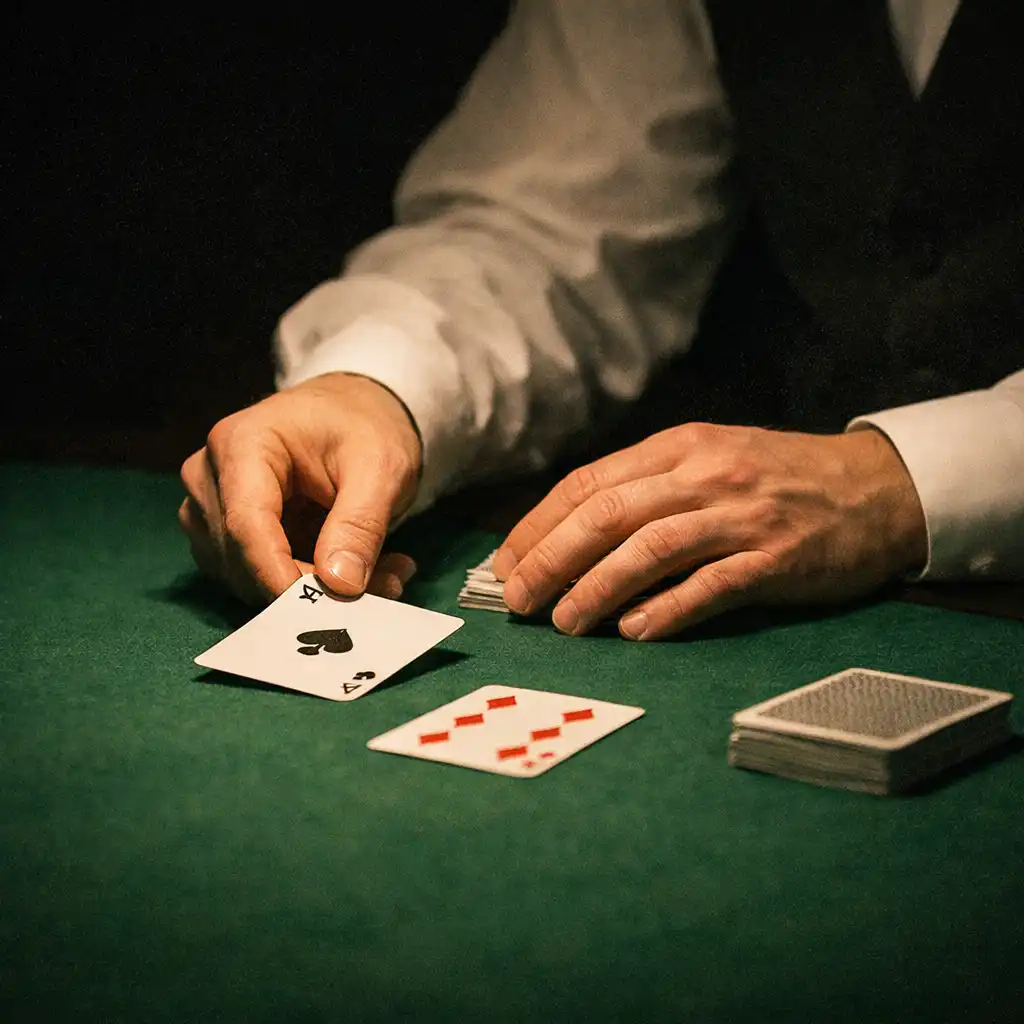
The casino is not merely a setting. It is a psychological pressure cooker where time, money, and risk are compressed into a single evening. At the card table, social masks slip. A character reveals themselves not through dialogue, but through the decisions they make when the stakes become unbearable. This page is dedicated to those revelations.
By the Character Desk · 12 min read
The Table as Stage
Why focus on characters instead of films? Because a plot can be summarised, but a character must be interpreted. The confined space of a poker table forces characters into close observation of each other. Every glance, every hesitation, every stack of chips pushed forward becomes a line of dialogue in a silent play.
The stakes—money, reputation, survival—intensify every gesture. A character's belief in luck versus skill reveals a deeper need for control. The casino's design, with its absence of clocks and windows, feeds compulsion and strips away the outside world. This approach allows for deeper psychological analysis than plot-driven reviews, and it is the lens through which we read every film in this section.
Character Archetypes
The Compulsive Gambler
A character driven by addiction, whose self-destruction is mirrored in the repetitive rituals of the casino. The gambler's belief in luck versus skill reveals a deeper need for control, even as the casino's design—no clocks, no windows—feeds the compulsion. Their arc is rarely about winning; it is about the moment they stop pretending they can stop.
The Cool Professional
A character who treats gambling as a craft, using discipline and observation to gain an edge. Their calm at the table contrasts with inner turmoil, and their skill is a form of control that may mask vulnerability. The casino environment rewards their patience but punishes any lapse.
The Desperate Outsider
A character who enters the gambling world out of necessity, bringing moral conflict and a fresh perspective to the corruption around them. The outsider's naivety highlights the casino's predatory nature, and their desperation makes them both sympathetic and dangerous. Their arc often involves a loss of innocence.
The Moment of Truth: A Close Reading
Consider the final hand—not a specific film, but a recurring scene in the grammar of gambling cinema. The lighting tightens. The camera moves closer to the faces. The sound design drops the ambient noise of the casino to a low hum, leaving only the whisper of cards and the click of chips. In this moment, the character's body language and dialogue contrast sharply with everything we have seen before. The confident smile is gone. The steady hands tremble. The outcome of the hand is less important than what it reveals about the character's values.
This is the moment of truth, and it is rarely about the money. A character who has spent the entire film performing control suddenly shows the cost of that performance. A character who has been reckless reveals a hidden calculation. The scene's staging—lighting, camera angles, and sound design—contributes to the revelation. The close-up on the eyes, the slow push-in on the cards, the pause before the bet: these are not just stylistic choices. They are the film's way of telling us that the mask is about to slip.
What makes these scenes endure is their refusal to provide easy catharsis. The character may win or lose, but the true stakes are internal. The moment of ruin is often quieter than expected—a single nod, a sigh, a hand withdrawn from the table. The moment of triumph can feel hollow. In both cases, the scene crystallizes the character's arc, forcing us to ask not what happened, but who this person has become.
Architecture of Desire
Can a place be a character? The casino's labyrinthine layout, sensory overload, and absence of time act as an antagonist or mirror to the people inside it. Its opulence masks a predatory intent, and characters' movements through the space reveal their psychological states.
The casino floor is designed to disorient. There are no straight paths, no visible exits, no natural light. The constant chime of slot machines and the murmur of the crowd create a wall of sound that isolates each player in a bubble of concentration. In this environment, the contrast between the public floor and the private back rooms highlights moral hierarchies. The high roller's suite, the manager's office, the security corridor—each space carries a different set of rules, and characters reveal themselves by how they navigate them.
The casino is not neutral. It rewards certain behaviours and punishes others. It seduces with luxury and then extracts a price. When a character walks through those doors, they are not just entering a building; they are entering a relationship. The architecture of desire shapes their choices, and in doing so, it becomes as much a character as any person at the table.
Character Gallery
Characters
The High Roller's Fall
A wealthy gambler's arrogance leads to ruin as the casino's luxury feeds his delusion. His wardrobe and demeanor signal status, but a key scene shows him overplaying his hand, revealing the fragility beneath the confidence.
Characters
The Dealer's Secret
A casino dealer observes the players' weaknesses from a unique vantage point. The dealer's neutrality masks personal stakes, exploring themes of power and invisibility.
Characters
The Poker Face
A character masters emotional control at the table but unravels outside it. The poker face becomes a metaphor for suppressed identity, questioning the cost of performance.
Critical Perspective
Against Redemption
Gambling films often fail their characters by forcing redemptive arcs. The compulsive gambler must hit rock bottom and then recover. The cool professional must learn to feel. The desperate outsider must escape the casino and return to a moral life. But redemption can undermine the tragic logic of addiction. It suggests that the casino's amorality is a temporary condition, a problem to be solved rather than a truth to be confronted.
The most compelling characters are those who remain unredeemed. They force audiences to sit with uncomfortable truths: that some people do not change, that some losses are permanent, that the house always wins. The casino's amorality is more honestly reflected in characters who do not change. These are the stories that linger, not because they offer hope, but because they refuse to lie.
Extended character studies for readers who want to go deeper.
Never Miss a Character Study
Subscribe to the Film Review Space newsletter and receive one free essay each week on the most compelling characters in gambling cinema.
About the Character Desk
Film Review Space is an independent publication based in New Zealand, written by film critics and essayists who focus on character-driven analysis. All essays are original and do not use official film stills. Reader feedback and suggestions are welcome at [email protected].